LLN Final Draft
Cover Letter for Language and Literacy Narrative
When completing this language and literacy narrative, my intention was to allow a reader to identify and relate with the story that I was telling. In this essay, when describing my experience in elementary school, I used imagery to describe not only the scenery, but how I viewed the whole experience so a reader could better identify with this experience if they had something similar happen to them.
One of the most meaningful insights I have made in this course is that standard English is not the best medium for all messages. Being a product of the New York City public school system, every English class drilled correct spelling, grammar rules, and proper punctuation. Since I wanted to do well in these classes, I learned how to make my writing conform to these standards. Through this phase, I’ve realizes that the public school system has done me a disservice in this regard. Standard and academic English is still a skill that I am thankful to have learned, but I regret not learning about how these rules can be bent for new, fresh, and creative writing that provokes new insights and thoughts.
Through peer review sessions done in Phase 1, I’ve learned a lot about my peers’ writing styles. I have yet to see two peers have the same writing style. Rather, I can hear everybody’s personal writing voice throughout the works I have seen through peer review. It helped me improve my own writing because I was able to see how everybody used the English language differently. Sometimes, people would have a clause with no predicate or no subject, but the way I saw that rule broken enhanced the meaning of the writing, the opposite of what I had been taught previously.
Another insight that I’ve been able to make is that language is so much powerful than I initially realized. Through readings like Mother Tongue, I’ve been able to learn more about others’ experiences with language and literacy outside of what I have seen from myself and my peers. In regard to Mother Tongue, it mentioned many language and literacy experiences that I could relate to as a son of two immigrant parents. I have spent my whole life translating and interpreting for my parents when they don’t feel confident in their own English skills, and I will continue to do so because society does look down on those who can’t speak standard English. When reading Nobody Mean More to Me than You and the Future Life of Willie Jordan, I learned even more about the dark side of language in relation to society’s standards to what is “proper.” Despite the content of the message that Jordan’s students describing a case of police brutality and injustice committed by the NYPD, their message was ignored by all newspapers because their message didn’t use a version of English that is traditionally accepted. I learned that language is more powerful than any of us may initially realize.
Terrible Twos
How do you quantify reading comprehension? Personally, I think it’s impossible to categorize someone’s writing into a numerical score based on a set of truly objective standards. However, NYC School District 24 seemed to disagree with me, because between kindergarten and second grade, P.S. 229 had a peculiar system in place to evaluate reading and writing. Students would be individually taken out of class by the teacher to read a passage and verbally answer some questions about what they read. As I was getting adjusted to second grade, assessment time rolled around.
“Vic! Can you come here?” Ms. Longo asked from the book corner as I was “diligently” working on my worksheet at my desk. I walked over next to where Ms. Longo was sitting and tried to get comfortable on the extremely small stool where students were meant to sit. After giving me a short passage to read, Ms. Longo asked me some questions about what I thought the character was feeling in the scene, why I thought the character was feeling that way, and more.
The questions felt more complicated than usual, using open-ended language and jargon I didn’t recognize. Despite the reading and prompts being more difficult, I still felt as if I was answering the questions properly. Ms. Longo never reframed the questions to try and guide me to different answers to the ones I gave her, so I figured I was on the right track. She wasn’t reacting to anything I was saying, maintaining a poker face the whole time, but I wrote that off as being her “assessment face.” After the assessment ended, without her telling me what score I received, I was feeling pretty good about my answers.
About two weeks later, the end of the first marking period rolled around, and I was eager to get my report card and see if I could use my grades to get some extra TV time at home. On past report cards, I usually saw mostly fours (very good) and some threes (good), so I had high hopes for my grades.
“Settle down, class!” Ms. Longo commanded in a deep voice as she walked around the classroom handing out orange manilla folders. The sound of heels clicking against the hardwood cut through the sound of chatter from my classmates freaking about their grades. Finally, I saw the infamous orange manilla folder outstretched in front of me. After undoing the metal fastener, I nervously pulled out the flimsy piece of copy paper and unfolded it.
A two?! I thought to myself, how did I get a two?! I couldn’t believe my eyes. Not only did I now lose TV time instead of gaining it, but I started to question my own capabilities. During the assessment, I felt like I had conveyed my thoughts in a clear manner, but it seemed like Ms. Longo disagreed. In my eyes, this new score told me that my personal perspective and experience when reading was wrong. My answers had to match what the answer key said, not what I truly thought a character was feeling in that passage.
Although I did pull up my grades the following marking period, my mindset changed from that point on. The fun was sucked out of reading and writing, because all I could think about was how to answer questions “the right way.”
Moving forward in English classes, these thoughts always crowded my mind, removing any individuality from my literary experiences and killing any interest I had in reading and writing. I understand that there will always a need for society to create metrics that gauge proficiency, especially when that data is meant to improve how we teach the next generation. However, I wish the socially accepted grading system focused on how to help students improve rather than ostracizing young, curious learners for their differences in perspective and lived experiences. A perfect example of curious learners being put down can be found in the United States’ college admissions process, a crucial part being the SAT, standardized exam. This exam determines not only where someone life will live and learn for four years, but also their future friends, career prospects, projected salary, and so much more. Yet, even today, we still resort to what I would call a barbaric methodology, particularly regarding SAT reading questions with fictional and/or subjective passages. During my Translation 1 presentation, I chose to give the class a practice SAT poetry question that I felt was too open-ended to be on this standardized exam.
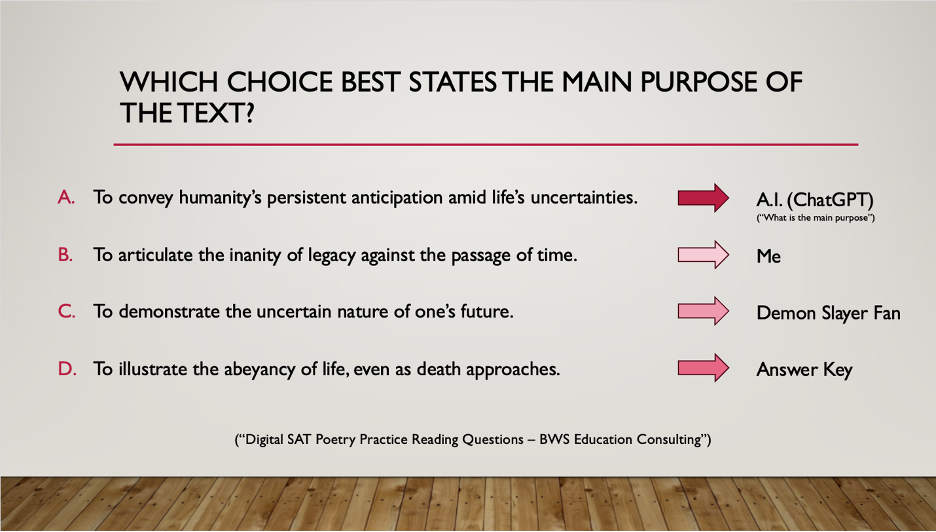
What I didn’t tell everybody was that these choices came from the sources described above. After polling the class, the most popular answer choice was C (Demon Slayer Fan). Rather than the “correct” choice being voted, an answer written by one of their peers was the most popular. This goes to show just how flawed these standardized exams can be. You’re punished by the system because you have your own interpretation of aa subjective passage based on your own lived experiences, so your only available options are to either knuckle down or fail.
During that assessment in the reading corner during the 2nd grade, I didn’t need to see a score that would scorn my academic experience for the rest of my life. I needed something to reaffirm my personal experiences and identity while also showing me another possible interpretation. I needed support from someone I could trust during my schooling, but what I got instead was a standardized number – 2.
Works Cited
“Digital SAT Poetry Practice Reading Questions – BWS Education Consulting.” Bwseducationconsulting.com, 19 Dec. 2023, www.bwseducationconsulting.com/digital-sat-poetry-practice-reading-questions/.
“What is the main purpose of the text in ten words or less using academic language similar to the SAT?” prompt. ChatGPT, 7 Aug. 2025 version, OpenAI, www.chatgpt.com.

This entry is licensed under a Creative Commons Attribution-NonCommercial-ShareAlike 4.0 International license.

