Synthesis Final Draft
Cover Letter
The immigrant experience isn’t something that could be described in words. No matter who you are and what your writing capabilities may be, words can never fully encapsulate the experience of being an immigrant. Being the son to two loving immigrant parents, I still don’t know and will never fully know the struggles they experienced, but through this essay, I hope to shine some light on an experience that not only my parents have suffered through in the past, but also so many immigrants who can’t share their story.
Ignoring the most necessities of water, food, and shelter, the next most important thing to survival is health. Given how far society has advanced, healthcare should be well-developed and able to serve the whole human populace. However, when new immigrants with limited proficiency in that nation’s language, healthcare becomes a labyrinth nearly impossible to navigate. The struggles that immigrants face from language and cultural barriers are not simple, but rather multi-faceted and complex in nature. This essay explores how exactly the healthcare system fails immigrants, using personal anecdotes, research, and multimodal sources to convey the depth of the challenges presented to immigrant healthcare.
Portfolio Draft of Synthesis Essay
The standard hospital experience for non-serious medical cases is that a patient goes to a hospital, gets treated by a healthcare worker, is given an aftercare treatment plan, and is discharged. When that patient is an immigrant, every step of this experience is ten times more difficult. To give a little taste of how a simple step can become so complicated, let’s look at this part of a discharge paper that a patient in China received.
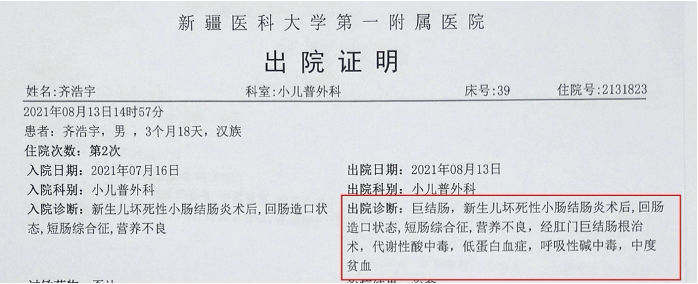
If someone with a limited understanding of the Mandarin received this discharge paper, they wouldn’t have the first clue about what this paper is telling them. A rough translation of the text in the red box is a description of a diagnosis for Hirschsprung’s disease in a three-month old patient.
For immigrants in the U.S. with limited English language proficiency receiving discharge papers, it is quite literally trying to read a foreign language, except in this case, that foreign language text explains extremely important information pertinent to someone’s health. This is just one example of a struggle immigrants face when being treated by the U.S. healthcare system.
In fact, a recurring theme that can be found from this example: accessibility to healthcare information and services before and after treatment/hospital visits. In the peer-reviewed article “Impacts of English language proficiency on healthcare access, use, and outcomes among immigrants: a qualitative study,” Dr. Mamata Pandey explores the different issues that arise from limited command of the English language through the lenses of the healthcare industry and its efficacy. Specifically, Pandey states that the ability to “secure appointments” and “post-appointment care” is directly correlated to one’s English language proficiency (Pandey et al.). Despite the ways that the U.S. healthcare system has improved with time, there are still many weaknesses that can be seen by those without much command of the English language. During my own father’s recent visit to the ER for his broken wrist, his eleven-page discharge papers were filled with plenty of medical jargon that I couldn’t even understand at some points. The part I would like to highlight is the first page: instructions for reaching out to a specialist for a follow-up appointment.
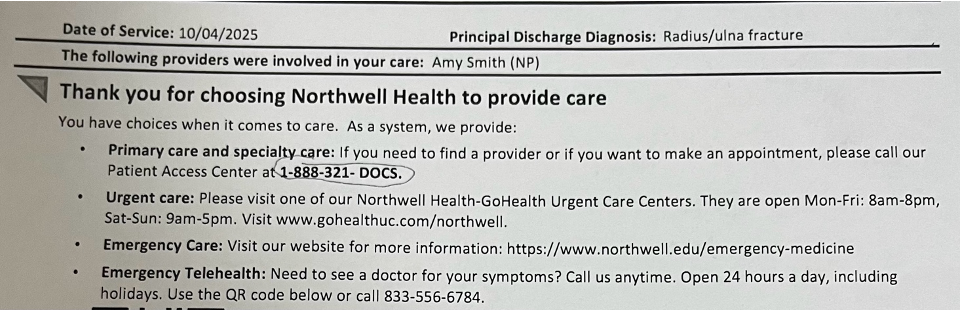
During the hospital visit, my father was given many assurances that the phone number given to schedule an appointment would have language interpreters available that could help with finding the right doctor for his situation. After being given this guarantee, my family felt comfortable with allowing my father, an immigrant who worried commonly about language barriers wherever he goes, to schedule his own appointment. However, when he called that phone number the next day, my father discovered that there were zero language interpreters available, resulting in a confusing phone call where no follow-up with a specialist was made.
The story I described is not unique. Both healthcare workers and immigrant patients alike struggle to communicate properly about important information and services before and after receiving treatment. In the peer-reviewed article “Impacts of English language proficiency on healthcare access, use, and outcomes among immigrants: a qualitative study,” Dr. Mamata Pandey illustrated the nature of these communication struggles through personal anecdotes from workers in the healthcare industry. One such worker in this study conducted by Dr. Pandey stated, “We need to make the community or the clients’ population know that this is available for you and this is the process how you get access to this service, the language barrier is a huge barrier for this population and to access like any health care service” (Pandey et al.). However, spreading medical awareness to communities that face a language barrier (like immigrant communities) is difficult because there are many struggles when trying to communicate through language interpreters.
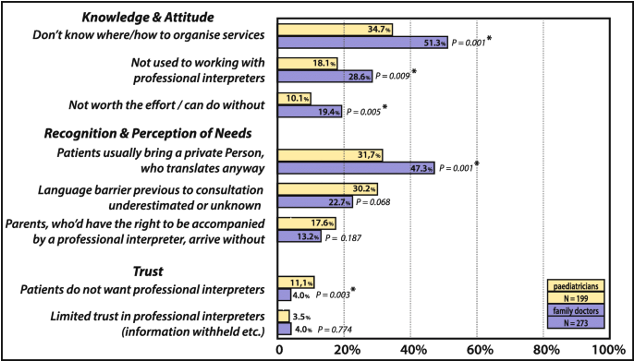
In the scholarly article “Barriers to and solutions for addressing insufficient professional interpreter use in primary healthcare,” academic researcher Fabienne N. Jaeger analyzed the barriers to using a language interpreter effectively. In the questionnaire-based study conducted by Jaeger to target healthcare professionals, she found that the main struggles to effective language interpreter usage were “cumbersome organization,” “absent financial coverage,” and “lack of knowledge on how to arrange interpreter interventions” (Jaeger et al.).
When a language barrier remains unaddressed due to a poor/nonexistent language interpreter experience, a healthy patient-doctor relationship can fail to develop for any number of reasons that could have been addressed by removing the language barrier. Due to immigrants coming from different regions of the world, they have different cultural viewpoints and perspectives on the role of healthcare compared to the culture of the country they immigrated to. As Dr. Pandey identified in her article “Impacts of English language proficiency on healthcare access, use, and outcomes among immigrants: a qualitative study,” many countries do not emphasize preventative care like how mainland United States does (Pandey et al.). This creates a disconnect between immigrants and their healthcare providers, reducing the quality of healthcare provided.
I can personally speak to this through my parent’s philosophy regarding medical treatment. In October of 2025, while working with a two-pronged screwdriver, I accidently cut myself along its sharp edge. Having grown up in the United States, my first thought was, when did I get my last tetanus shot? My father and uncle both said that it was a small cut and I was blowing it out of proportion. To be on the safe side, I contacted my doctor’s office and was told that the effectiveness of my last tetanus shot was already gone and that I needed to get the Tetanus shot within the next 24-48 hours. This is a perfect case of the cultural disconnect that can be seen between healthcare workers and immigrants. There are many different healthcare values that immigrants must navigate, but there aren’t any effective solutions that address this problem.
A healthcare worker in Pandey’s study gave the following example: “Say I am treating an ear infection. I have told the clients many times that the medication is to be administered by mouth, but they thought it was to be installed in the ears. So, I have a couple of disastrous cases where I have prescribed medication where they don’t realize it is given by mouth. I think also, when they don’t understand, they feel uncomfortable to ask for clarification. They get very embarrassed and they get very frustrated” (Pandey et al.). Through this situation, another massive disconnect can be seen between the healthcare worker and their patient. When the bridge of trust isn’t built between patient and healthcare provider, an adverse outcome is almost always imminent. Due to the background that the patient comes from and the unfamiliar environment they are being placed in, the quality of healthcare became worse.
In extreme examples where some immigrants face a combination of all the factors discusses above, the result is disastrous. Amy Tan, a popular author known for her novels and short stories, in her essay “Mother Tongue,” discusses in detail her mother’s experience during a hospital visit as someone who didn’t speak “standard English” (Tan). When Tan’s mother visited the hospital to receive a consultation about a benign brain tumor discovered during a CAT scan, she was told in an apathetic manner that she visited for no reason because the hospital lost the CAT scan and to get any more information, she would have to schedule another appointment. In the face of this challenge, Tan’s mother stood her ground, insisting that the hospital call her daughter who spoke “perfect English” (Tan). Once Amy Tan herself had been reached, promises that the CAT scan would be found and apologies for “a most regrettable mistake” were made (Tan).
The inhumane manner that Tan’s mother was treated highlights how the struggles immigrants face when receiving healthcare not only compound, but they also grow exponentially, where each struggle adds to the impact of the others. Assuming that the healthcare workers Tan’s mother was addressing could not communicate their thoughts properly due to a language barrier, no corrective measures like a language interpreter were even taken by the healthcare provider for reasons unknown. Moreover, the healthcare workers’ background and opinions on immigrants/those with limited English proficiency may have also played a factor in how Tan’s mother had been treated. As a result, what was already a strained healthcare relationship has collapsed even further into ruin by this disastrous experience.
The struggles that immigrants face when approaching the healthcare system are only exasperated by the current political climate where debates are sparked across the political spectrum regarding immigration policy. The context of immigrants and healthcare is relevant to the recent passage of the One Big Beautiful Bill Act by Sitting President Donald Trump. One policy change in this bill involved healthcare funding, restricting access by excluding certain legal immigrant groups to certain health and social programs like Medicaid, Medicare, ACA, and SNAP benefits (“FAQ: The One Big Beautiful Bill Act Tax Changes”). In addition, funding for emergency services provided to states via. Emergency Medicaid are being cut, forcing states to foot more of the cost (“FAQ: The One Big Beautiful Bill Act Tax Changes”). To those not affected directly by these policies, it can be easy to brush off. However, these laws directly impact the lives of so many immigrants by restricting their access to healthcare even further than before.
All these factors described in this essay can only hope to offer a glimpse into the variety and severity of challenges that immigrants face during their most vulnerable health-related moments. From the volatile political climate to failures in addressing information, language, and cultural barriers in healthcare, the immigrant struggle to accessing quality healthcare is an uphill battle.
Works Cited
“FAQ: The One Big Beautiful Bill Act Tax Changes.” Tax Foundation, 25 July 2025, taxfoundation.org/research/all/federal/one-big-beautiful-bill-act-tax-changes/. Accessed 15 Nov. 2025.
Jaeger, Fabienne N., et al. “Barriers to and Solutions for Addressing Insufficient Professional Interpreter Use in Primary Healthcare.” BMC Health Services Research, vol. 19, no. 1, Oct. 2019, https://doi.org/10.1186/s12913-019-4628-6. Accessed 12 Nov. 2025.
Pandey, Mamata, et al. “Impacts of English Language Proficiency on Healthcare Access, Use, and Outcomes among Immigrants: A Qualitative Study.” BMC Health Services Research, vol. 21, no. 1, July 2021, pp. 1–13, https://doi.org/10.1186/s12913-021-06750-4. Accessed 9 Nov. 2025.
Tan, Amy. “Mother Tongue.” The Threepenny Review, no. 43, 1990, pp. 7–8.
齐浩宇. “出院证明.” Baidu, Online Image, 13 Aug. 2021, image.baidu.com/search/detail?adpicid=0&b_applid=7473660471018896287&bdtype=0&commodity=©right=&cs=552626845%2C202458127&di=7562963243866521601&fr=click-pic&fromurl=http%253A%252F%252Fnews.sohu.com%252Fa%252F687392969_120873932&gsm=1e&hd=&height=0&hot=&ic=&ie=utf-8&imgformat=&imgratio=&imgspn=0&is=0%2C0&isImgSet=&latest=&lid=88d5e4a601fce0b4&lm=&objurl=https%253A%252F%252Fp5.itc.cn%252Fimages01%252F20230620%252F708b6d420d244454a4a6204e686697c7.jpeg&os=3946005703%2C4162269463&pd=image_content&pi=0&pn=1&rn=1&simid=3329350900%2C250620017&tn=baiduimagedetail&width=0&word=%E5%87%BA%E9%99%A2%E8%AF%81%E6%98%8E&z=. Accessed 8 Nov. 2025.

This entry is licensed under a Creative Commons Attribution-NonCommercial-ShareAlike 4.0 International license.

